The rules that actually matter
How to play pickleball online
If you have played tennis in a browser, throw out the muscle memory. You cannot stand on the kitchen line and smash everything. You cannot volley the serve. You will lose points that way, and the game is not being unfair — that is the sport. The good news: pickleball has fewer rules than tennis, and the ones that matter fit on this page.
The 60-second version
- Serve underhand, diagonally, past the kitchen.
- Let the serve bounce. Let the return bounce. Then volleys are legal.
- Never hit the ball in the air while standing in the kitchen (the seven-foot zone by the net, line included).
- Rally scoring to 11, win by 2. Every rally scores a point.
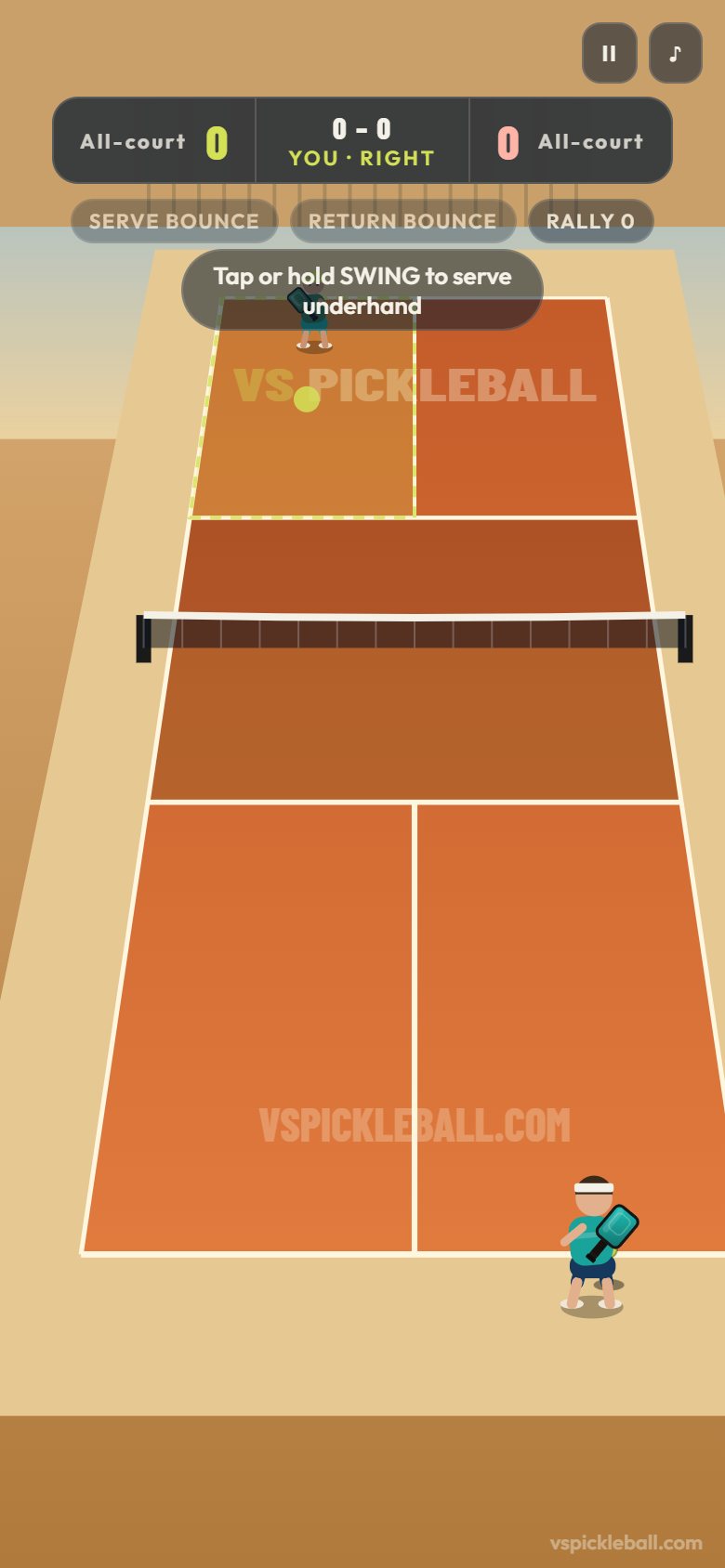
- Tap Space to dink, hold Space to speed-up. On phone, tap or hold SWING.
That is enough to start a game. The rest of this page is why each rule exists and how to use it.
The court
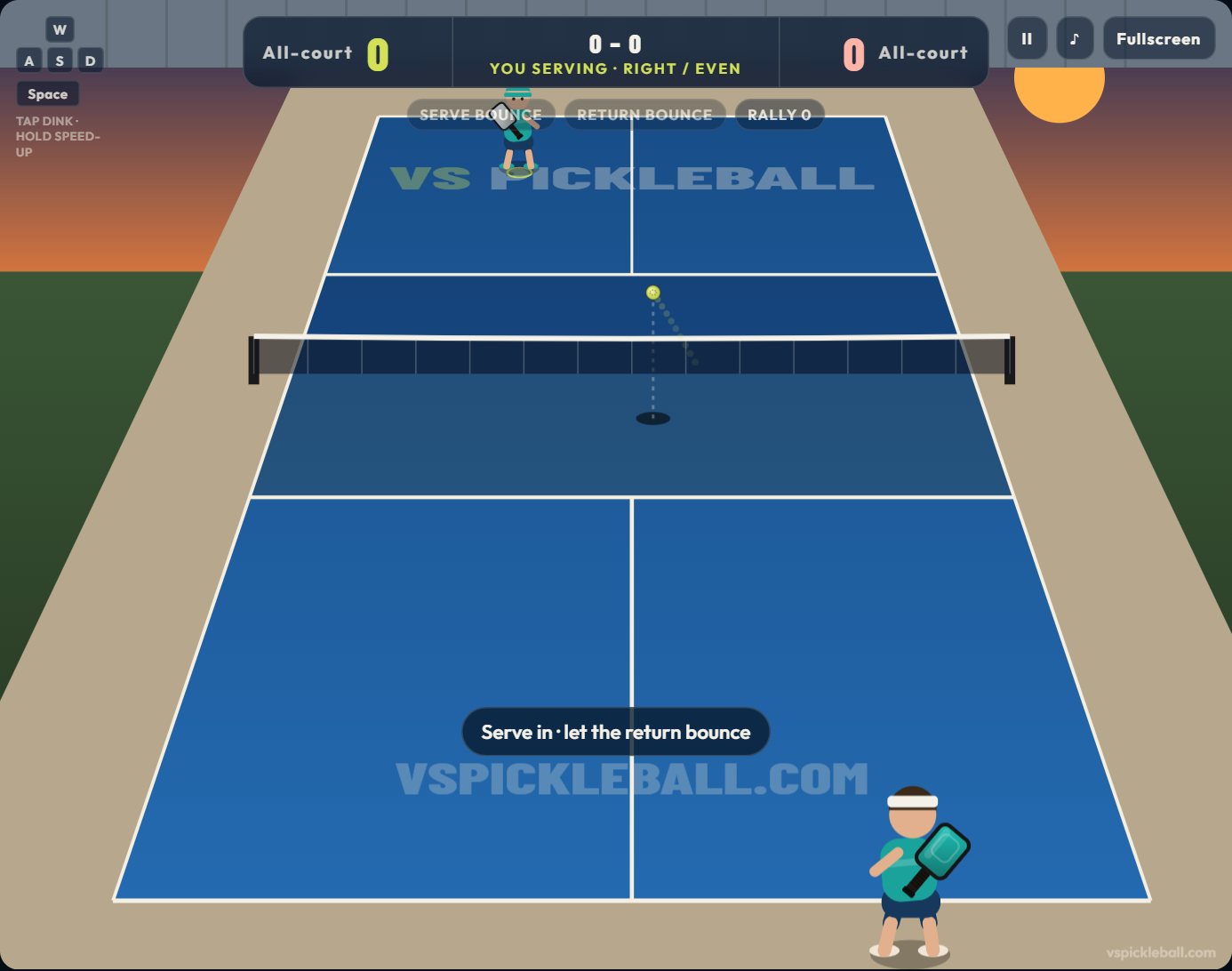
Twenty feet wide, forty-four feet long. The net sits in the middle: 36 inches at the sidelines, 34 inches in the center. Seven feet in front of the net, on both sides, is the kitchen. The kitchen includes the line. If your feet are on that line and you hit the ball in the air, that is a fault.
You look up the court from the near baseline. The far player is smaller because of perspective, not because their half of the court is shorter. Deep balls still land near their baseline.
Serving
Serves are underhand, from behind the baseline, into the diagonal box. Even score, you stand on the right. Odd score, the left. The serve cannot land in the kitchen or on the kitchen line. If it clips the net and still lands in the box, it is live. There is no let serve in current USA Pickleball, and there is no let serve here.
On a keyboard: hold Space (or click) to serve. A and D aim the box while you stand. A stronger Serve stat sends the ball deeper and keeps it lower after the bounce. A weak serve sits up — easy to attack if you let it hop.
The two-bounce rule
The serve has to bounce. The return has to bounce. After those two hops, volleys are legal. If you punch the serve out of the air, you will see a warning instead of a lucky winner. Let it bounce, then swing.
That rule is why people walk in after the third shot. You cannot camp the net on the return. You play the bounce, then you take the kitchen.
The kitchen
You may stand in the kitchen. You may hit a ball that has already bounced there. You may not volley while you are in it. In this game, walk up with W until you are just behind the line. Do not step through it and keep swinging at balls in the air.
A tap on Space is a dink: a soft ball meant to land in their kitchen. Hold Space and the bar fills. Green is still a dink. Yellow is a speed-up — the punch you see at the line in real matches. Low balls: let them bounce, then tap. High balls: hold yellow and take it out of the air. If you hold Space as a high ball arrives, the paddle will punch when it is in range.
That is the rally people mean by “hands.” Both sides on the line, dinking until someone pops the ball up, then a few fast exchanges. Doubles lives there. Singles comes in too, but there is more open court to miss into.
Scoring
Games are to 11, win by 2. This version uses rally scoring: win the rally, you get the point, whether you were serving or not. If the other side was serving and they hit out, miss, or dump into the net, you score. If they were serving, you also take the serve — except in doubles, where the first fault on a team can still go to the second server.
Traditional pickleball is side-out scoring (only the server scores). It is easy to sit through a long receiving game with the score stuck at 0–0 and think the game is broken. Rally scoring is the browser choice. The faults themselves — out, kitchen, two-bounce, net — still mean what they mean on a real court.
Keyboard and phone
- WASD — move. Also aim: A/D for left and right, W deeper, S shorter. The yellow pip on the court is the intended land.
- Space — tap to dink, hold to charge. Same as a click on the court.
- Player 2 — arrows and Enter.
- Phone — left stick to move and aim, SWING to tap or hold.
Empty swings in the kitchen are legal. Hitting the ball in the air in the kitchen is not. If a replay starts on an ace or a long kitchen rally, Space or a click skips it.
Building a player
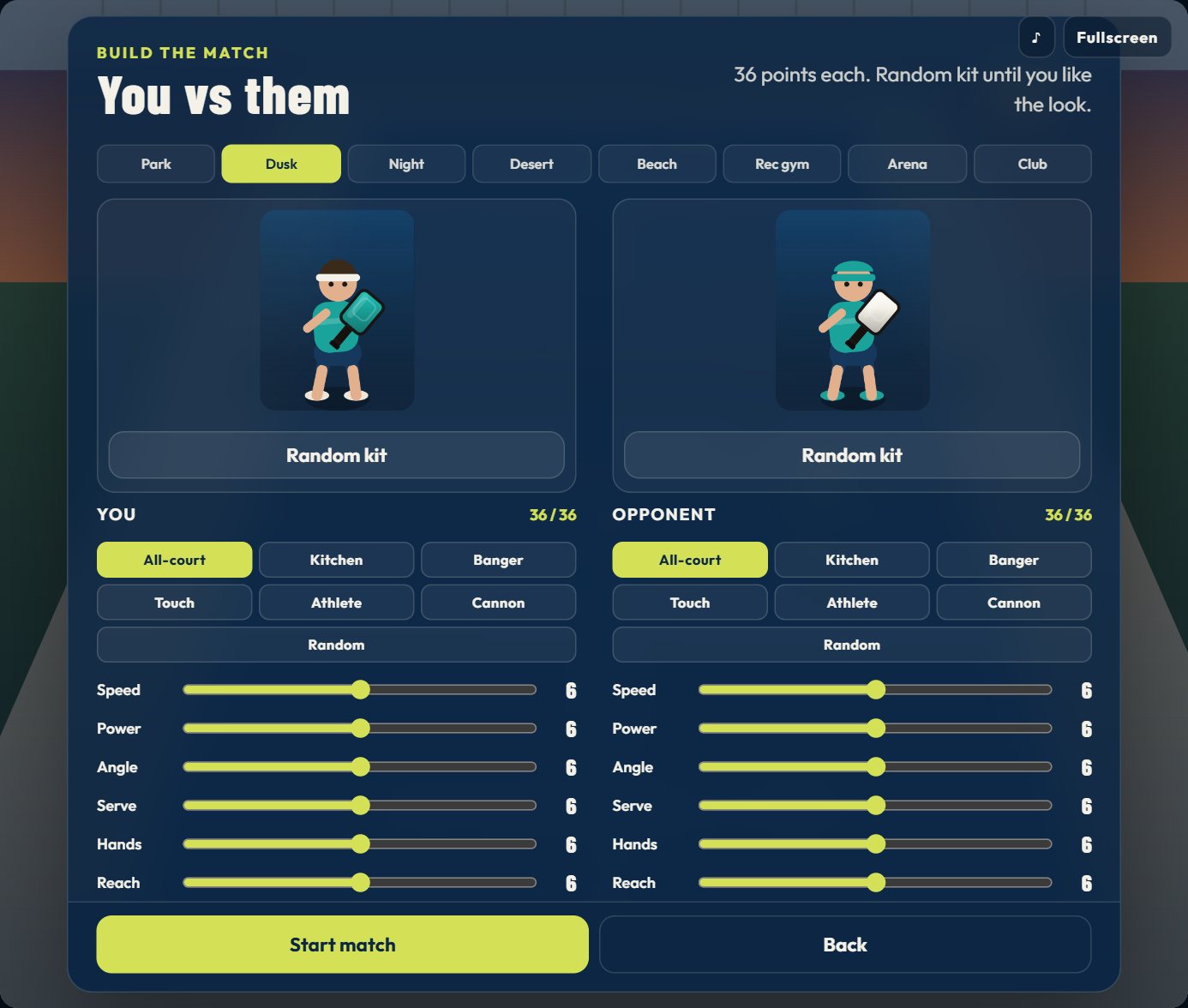
Before a match you can mash Random kit until the person on the left looks right. Then you split 36 points across Speed, Power, Angle, Serve, Hands, and Reach. Speed is foot speed. Power is pace on drives and speed-ups. Angle is whether drives stay in. Serve is depth and how much the bounce sits up. Hands is kitchen range and how fast you recover. Reach is how far the paddle actually is — if you are not there, it is a whiff.
On Normal, a computer with all sixes will get many balls back, but not all of them. Hit wide. Hit behind them. Do not feed the middle of the kitchen and expect them to miss.
Doubles and the tournament
In doubles you control the near player. Your partner is AI and will hold a lane. The first serve of the match is the 0–0–2 sequence: one serve only, then the other team. After that both players on a side serve.
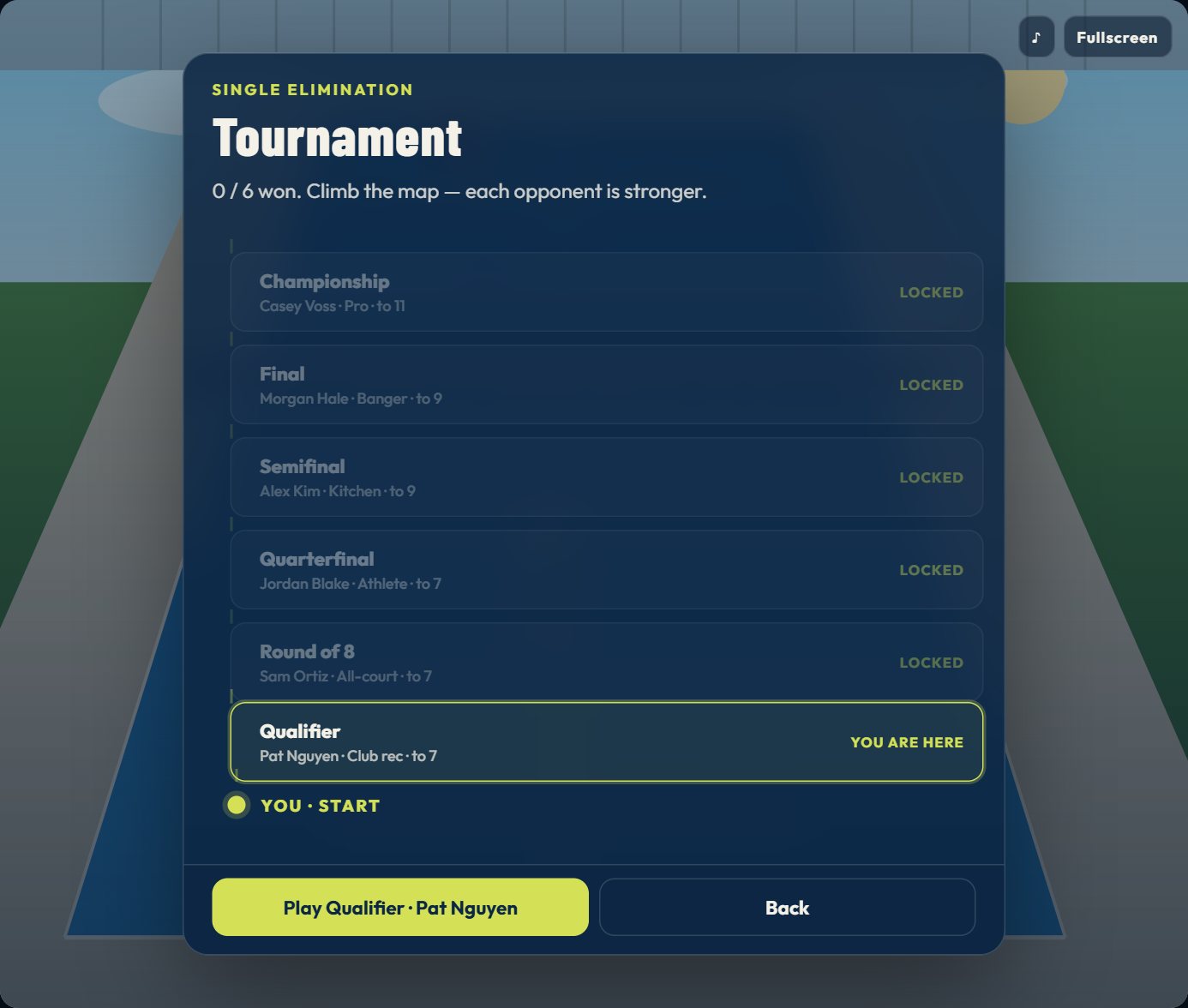
Tournament is six rounds, weak to strong, and one loss ends the run — you start again from Round 1 with fresh boosts. Scout the opponent before you play. Best grades per round are kept on this browser until you clear the site data.
Pickleball terms you will hear
- Kitchen / non-volley zone (NVZ)
- The seven-foot strip on each side of the net. You can stand in it and hit balls that have bounced. You cannot volley from it.
- Dink
- A soft shot from the kitchen line that lands in the opponent’s kitchen. The point of a dink is to make the other side hit up, so you can attack.
- Third-shot drop
- The serving side’s third ball: a soft drop into the kitchen that buys time to walk up to the line. The two-bounce rule is what makes this shot exist.
- Speed-up
- A sudden hard ball out of a dink rally, usually aimed at a body or a backhand. Hold Space until the bar goes yellow.
- Two-bounce rule
- The serve and the return must both bounce before anyone volleys. Also called the double-bounce rule.
- Rally scoring vs side-out scoring
- Rally scoring: whoever wins the rally scores (used here). Side-out: only the serving side can score (traditional tournament rule).
- Erne
- Volleying from outside the sideline, next to the kitchen, without touching it. Legal, difficult, and not something the AI will let you do often.
Play the free online pickleball game when you want to hit something.