Guides · Rules
The kitchen rule, properly explained
Take the kitchen out of pickleball and you get a small tennis court where the tallest player stands at the net and slams everything. The seven-foot strip on each side of the net, formally the non-volley zone and universally called the kitchen, is the rule that makes dinking exist, makes the third-shot drop worth learning, and makes a 5-foot-4 player with good hands a problem for anyone. It is also the rule beginners get wrong most, usually because someone told them “you can’t go in the kitchen,” which is not what it says.
What the rule actually says
Here it is in one sentence: you may not volley a ball while any part of you is touching the non-volley zone, including its lines.
Three words in that sentence do all the work.
- Volley means hitting the ball out of the air, before it bounces. If the ball has bounced, it is not a volley, and the kitchen rule does not apply to that shot at all.
- Touching means physical contact with the surface. Your foot, your other foot, a hand if you fall, a dropped paddle, a hat that comes off, a shoelace. The kitchen is a patch of ground. It is not a wall going up into the air.
- Including its lines means the line is part of the zone. A toe on the line while volleying is a fault, no matter where the rest of you is.
Everything else, every scenario people argue about at the net, comes from applying those three words carefully.
The zone itself
Measured from the net, the kitchen is 7 feet deep on each side and the full 20-foot width of the court. Because the line counts, the effective no-volley area is 7 feet plus the width of the line. The zone is defined as a two-dimensional area on the court surface; the air above it is not restricted. That single fact explains the Erne, the reach-over volley, and most of the surprising legal shots below.
What you are allowed to do in the kitchen
This list surprises people who learned the rule as a prohibition on entering.
- Stand in it. Any time, for any reason, for as long as you like. There is no rule against being in the kitchen.
- Hit a ball that has bounced there. A dink that lands in your kitchen can be played from inside your kitchen. That is the entire dinking game.
- Reach over it. If your feet are behind the line, you may lean as far forward as you can and volley the ball above the kitchen. Your paddle and body can be in the air above the zone; only ground contact matters.
- Run through it to chase a ball, as long as you do not volley while you are in contact with it.
- Jump over it from outside to outside, volleying in mid-air. That is the Erne, covered below.
The five ways to fault in the kitchen
1. Volleying while touching the zone
The obvious one. Foot on the line or inside it, ball hit before it bounced: fault, point over. The most common version is not a deliberate step in but a player who has been dinking with a foot on the line and forgets to step back when a ball pops up and they want to attack it.
2. Momentum after the volley
You volley with both feet legally behind the line, but the swing carries you forward and a foot lands in the kitchen. That is a fault, and it stays a fault even if the ball is already dead by the time you touch. The act of volleying includes the swing, the follow-through, and everything your momentum makes you do. If you hit a clean winner and then stumble onto the line while the ball is rolling away, you lost the point. Officials will call this every time, and it is the fault that catches strong players most, because aggressive volleys generate the most momentum.
The fix is technique: volley with your weight balanced, and if you have to lunge, lunge sideways along the line rather than forward through it.
3. Anything you wear or carry touching the zone
While volleying, if your paddle touches the kitchen, or your hat falls into it, or your sunglasses, or a ball from your pocket, it is a fault. The rule covers you and anything attached to you. The paddle is the realistic case: a low volley scooped up from ankle height where the paddle tip taps the surface inside the line.
4. Your partner touching you
In doubles, if your partner is standing in the kitchen and touches you while you are volleying, that is a fault. You are volleying, and something in contact with the kitchen is in contact with you, so the chain reaches the ground. The usual version is a partner who steps in to cover a dink, then reaches out to steady you or brushes your arm as you punch a volley. It is rare, and rarely called in recreational play, but it is in the book.
5. Jumping from inside and volleying before re-establishing
Once you have been in the kitchen, you must have both feet touch the ground outside the zone before you are allowed to volley again. You cannot stand in the kitchen, jump, hit the ball in the air, and land behind the line and call it good. You started the volley from a kitchen position. Equally, you cannot step out with one foot and volley while the other is still coming; both must be re-established outside.
The Erne and the reach-over
Because the zone is flat, two shots that look illegal are not.
The reach-over is simple: feet behind the line, lean in, take the ball out of the air above the kitchen. It is how good players attack a slightly high dink without giving up position. The risk is fault number 2: reaching too far and falling in.
The Erne, named after Erne Perry, is the spectacular one. A player sees a dink heading down the sideline, runs around the side of the kitchen (or jumps across the corner of it), and volleys the ball from outside the sideline right next to the net, before landing out of bounds. It is legal because at the moment of contact and on landing the player is touching ground outside the non-volley zone. Out of bounds is fine; the kitchen is not. Two things make it a fault: taking off from inside the zone, or landing with a foot on the kitchen line after the volley. The same logic applies if you run around the kitchen on foot and stand outside the sideline: as long as you did not volley from inside the zone and you are not touching it, you may volley from there.
The other kitchen rule: the serve
The kitchen also shows up in the serving rules, in the opposite direction. A serve must clear the non-volley zone, including the line. A serve that lands on the kitchen line is a fault, even though for every other shot in the game a ball on any line is in. Keep the two things separate in your head: for volleys, the line is dangerous for your feet; for serves, the line is dangerous for the ball. Details are in the serving rules guide.
Why the rule exists, and what it does to strategy
Without the kitchen, the side that gets to the net first wins nearly every rally, because a ball popped up anywhere can be put away from a foot off the net. The seven-foot buffer means a player at the line is still a paddle-length and more from the net, and a low ball dropped into the zone cannot be attacked out of the air; it has to bounce first, and then it is below net height and has to be lifted. That is a dink, and the person who dinks with more patience and better placement usually gets the pop-up they need.
So the kitchen produces the rhythm that defines the sport: both sides at the line, soft exchanges, a slightly high ball, a speed-up, a scramble. It also creates the third-shot drop. The serving team, stuck at the baseline by the two-bounce rule, cannot rush the net behind a hard drive because the receivers are already there and can volley. Instead they drop the third ball softly into the kitchen, where it must bounce, and walk in behind it.
How the browser game enforces it
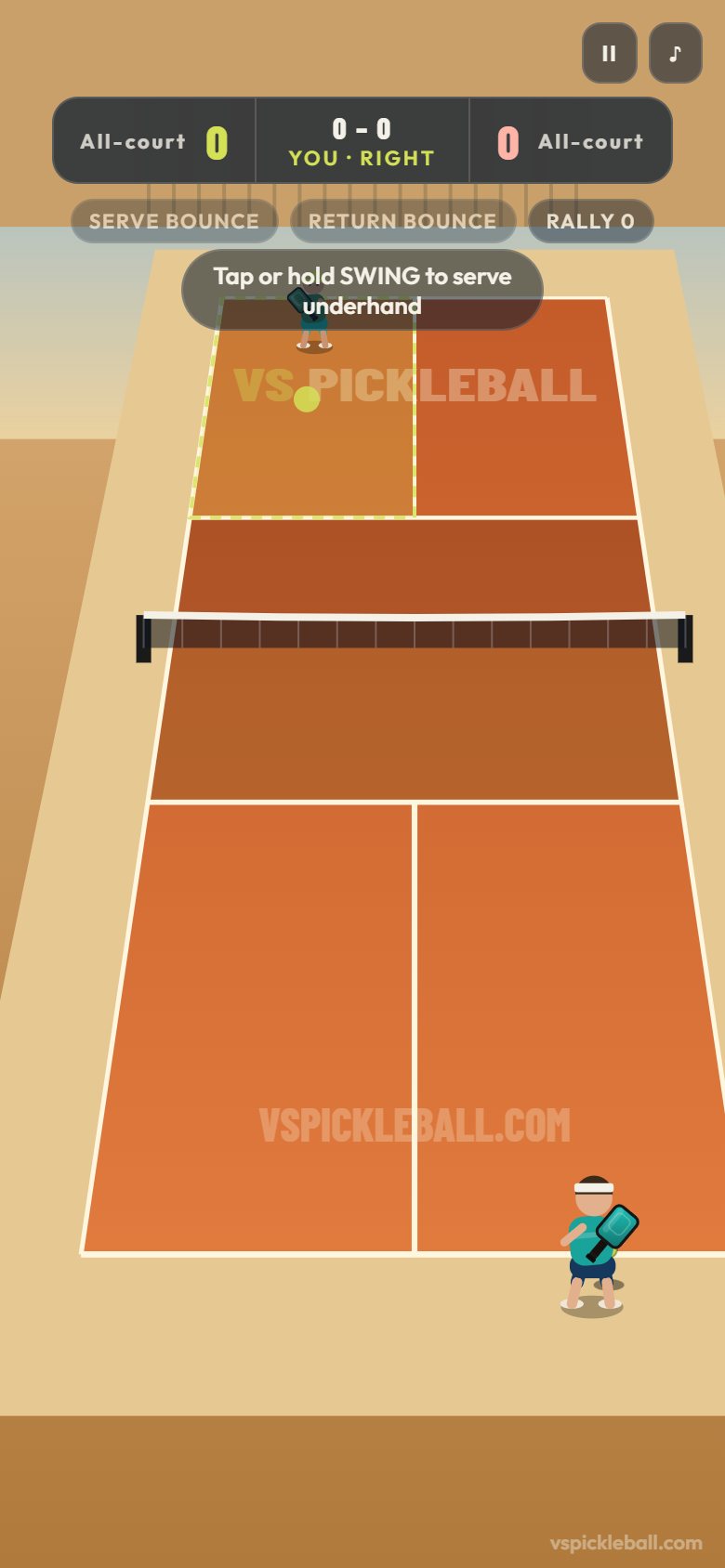
The free online pickleball game on this site treats the line as part of the zone and checks your feet at the moment of contact. Step on the line and hit a ball out of the air and you get a fault, with a short message so you know why. Balls that have bounced are fair from anywhere. Momentum faults are not modelled, since the players stop where you put them, which is one of the few ways the game is kinder than a real court. Walk up with W (or the stick on a phone) until you are just behind the line and stay there; the how-to-play page has the controls.
Common questions
- Can I stand in the kitchen?
- Yes, any time. You just cannot volley while touching it.
- Is the kitchen line in or out?
- For your feet, the line is part of the kitchen: touching it while volleying is a fault. For a served ball, landing on the line is a fault (short). For any other shot, a ball on the line is in.
- My momentum carried me in after the ball was dead. Fault?
- Yes. Momentum from a volley into the kitchen is a fault regardless of where the ball is.
- Can I volley a ball that is above the kitchen if my feet are behind the line?
- Yes. The zone is the ground, not the airspace.
- Can I step in, let the ball bounce, and hit it?
- Yes. That is the normal way to play a dink.
- After I leave the kitchen, how soon can I volley?
- As soon as both feet have touched the ground outside the zone.
- Does the kitchen rule apply to the serve return?
- The return has to bounce anyway under the two-bounce rule, so it can never be a volley. The kitchen rule only matters from the third shot on.
Keep going: the serving rules, including why a serve on the kitchen line is out, and how scoring works once the rally is over.
Or go and get called for a kitchen fault a few times until it sticks.