Guides · Rules
Pickleball scoring explained
Nothing about pickleball confuses a new player more than the score. The court makes sense in ten seconds and the kitchen rule takes a minute. Then someone shouts “four–two–one” before a serve and you realise you have no idea who is winning, who is serving, or why there are three numbers. This page fixes that. By the end you will be able to call a doubles score out loud, know which side of the court to stand on without asking, and understand why the browser game on this site scores slightly differently from your Saturday group.
The basics everyone agrees on
- Games are played to 11 points, and you must win by 2. 11–10 is not over; 12–10 is.
- Tournaments sometimes play to 15 or 21. The win-by-2 rule still applies.
- A rally ends with a fault: ball out, ball into the net, a volley from the kitchen, hitting the serve or return out of the air, a double bounce on your side, the ball touching you or your clothing, and so on.
- Who gets the point for that fault depends on the scoring system. There are two.
Side-out scoring: the traditional system
This is the system in the USA Pickleball rulebook and the one almost every club and recreational group uses. The rule that drives everything else is simple and a little cruel: only the serving side can score.
If you are serving and win the rally, you get a point and you serve again. If you are serving and lose the rally, nobody scores; you just lose the serve. If you are receiving and win the rally, you do not get a point either. You win the right to serve, and now you can start scoring. Losing the serve is called a side-out, which is where the name comes from.
This is why scores in side-out pickleball creep along. A great rally that ends with the receiver ripping a winner down the line changes the score from 5–3 to… 5–3. It just changes who is serving. New players sometimes think the scoreboard is broken. It is not. The game is designed so that you have to earn the serve and then earn the points.
Singles: two numbers
In singles the score is called as two numbers: server’s score first, receiver’s score second. Always the server first, regardless of who is ahead. If you are serving at 3 and your opponent has 7, you call “three–seven.”
Where you stand is decided by your own score. Even score, serve from the right-hand side. Odd score, serve from the left. Zero counts as even. Your opponent’s score has nothing to do with it. Because you keep serving from alternating sides as your score goes up, you serve diagonally into each box in turn, which is the whole point of the rule.
Doubles: three numbers
Doubles is where the third number appears. The call is serving team’s score – receiving team’s score – server number. Server number is either 1 or 2 and tells everyone which of the two partners is currently serving.
| Call | Meaning |
|---|---|
| “4–2–1” | Serving team has 4, receivers have 2, the first server of this turn is serving. |
| “4–2–2” | Same score, but the first server already lost a rally and the second partner is now serving. |
| “0–0–2” | Start of the game. See below. |
| “10–9–2” | Serving team is one point from winning on their second server. If they lose this rally, it is a side-out. |
Here is how a serving turn goes in doubles. Partner A serves. As long as the team keeps winning rallies, A keeps serving, switching sides each point (even right, odd left, based on the team’s score). When A finally loses a rally, the serve does not leave the team yet: it passes to partner B, who is now “server 2.” B serves until the team loses another rally. That second loss is the side-out, and the other team starts serving with their own server 1.
So each team gets two servers per turn, one after the other. The server number is not a fixed label for a player. Whoever serves first in a given turn is “1” for that turn, and it is always the partner standing on the right-hand side when the turn begins.
Why the game starts at 0–0–2
The first serve of a doubles game is called “zero–zero–two,” sometimes “zero–zero–start.” The team that serves first only gets one server before a side-out, not two. The rulebook does this by declaring that first server to be server number 2 from the outset. It is a handicap: serving first is an advantage, and giving the opening team only one serving chance keeps things fair. Once the first side-out happens, every serving turn for the rest of the game has the normal two servers.
Where to stand in doubles
The same even-right, odd-left rule applies, based on the serving team’s score. The practical trick is to remember where you started. The player who served first for your team at the start of the game will always be on the right when your score is even and on the left when it is odd. If that player is on the wrong side for the score, someone has lost track and you should sort it out before the serve, because serving from the wrong position (or the wrong partner serving) is a fault if it is caught.
Receivers do not move. Only the serving team switches sides, and only when they win a point.
Rally scoring: the newer system
Rally scoring is what almost every other racket sport already does: the side that wins the rally gets the point, whether or not they served. There are no “dead” rallies. Every point moves the score.
It has been the standard in Major League Pickleball (MLP), whose games go to 21 with a “freeze” near the end so that a team can only close out the game on its own serve. USA Pickleball has also been trialling rally scoring as a provisional option for sanctioned events. Recreational groups mostly still play side-out, but if you play in a league that is short on court time you will meet rally scoring, because games finish faster and the length is predictable.
Serving order in rally scoring is simpler too. In the common doubles version, each team has one server per turn, decided by the score: the partner on the right serves at even scores, the partner on the left at odd. Lose the rally and the other team serves. There is no server number to call, so the score is just two numbers again.
What the game on this site does
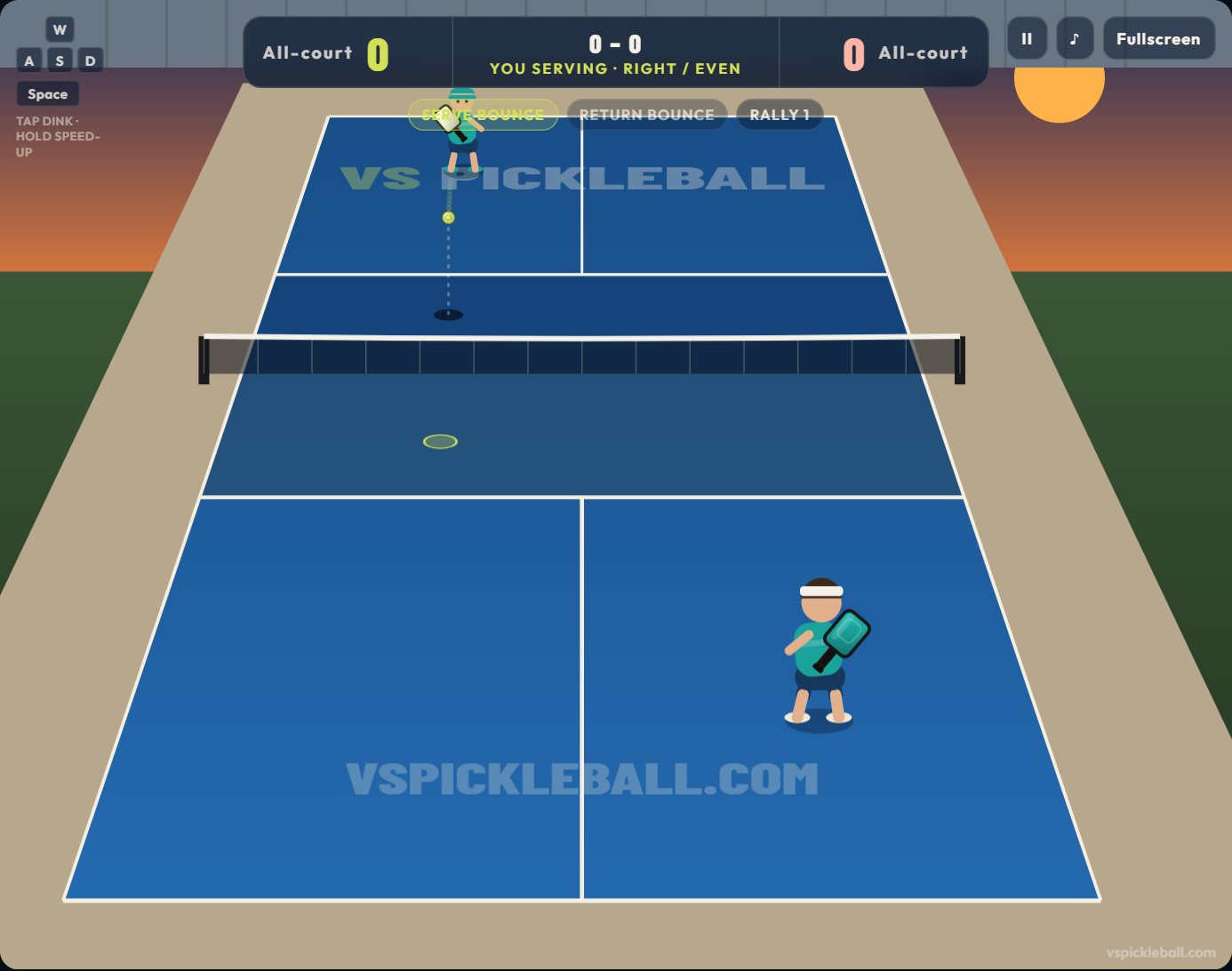
The free online pickleball game here uses rally scoring to 11, win by 2. Two reasons. First, browser matches need to end in a few minutes, and side-out scoring in a close game can run twice as long. Second, a long receiving stretch where the score never moves feels like a bug on a screen, even though it is perfectly normal at a club. Everything else is standard: the faults are the real faults, serves alternate sides by score, and in doubles the first fault on a serving team still hands the ball to the second partner before the side-out. The how to play page covers the controls.
Side-out vs rally: what actually changes
| Side-out scoring | Rally scoring | |
|---|---|---|
| Who can score | Only the serving side | Whoever wins the rally |
| Score call (doubles) | Three numbers | Two numbers |
| Servers per turn | Two (one at the start of the game) | Usually one |
| Game length | Variable, can run long | Predictable |
| Strategy | Receiving well is defensive; you protect the score | Every rally is worth the same, so risk is priced the same way on both sides |
| Used by | USA Pickleball rulebook, most clubs and tournaments | MLP, some leagues, provisional tournament option, this game |
How to stop losing track of the score
- Call the whole score before every serve, out loud. It is required in tournaments and it is the only reliable memory aid. “Six–four–two.” If your partner disagrees, you sort it out before the ball is hit, not after.
- Anchor on your first server. In doubles, note who served first for your team. That person on the right means your score is even; on the left means odd. Instant sanity check.
- Receivers: track the server number. The receiving team has nothing else to do between points. Knowing whether the opponents are on server 1 or 2 tells you how close you are to getting the ball back.
- Use the 10 seconds. Once the score is called, the server has 10 seconds to serve. That is plenty of time to fix a wrong call. Nobody minds a pause; everybody minds replaying three points.
Common questions
- What does 0–0–2 mean?
- The opening score of a doubles game: 0 for the serving team, 0 for the receivers, and the server is treated as server number 2, so the first serving team gets only one server before the first side-out.
- Do you have to win by 2?
- Yes, in both scoring systems. Games go to 11 (or 15, or 21) and continue until one side leads by 2.
- Can the receiving team score?
- Not under side-out scoring. Winning a rally as a receiver earns the serve, nothing more. Under rally scoring, yes, every rally is a point for someone.
- Which side do I serve from?
- Even score, right side. Odd score, left side. It is your team’s score that counts, not the opponents’.
- What happens if we served from the wrong side?
- If it is spotted before the serve, correct it. If it is spotted after the rally under USA Pickleball rules, the serving side is charged with a fault, but only if the error is called before the next serve. Once the next serve happens, the rally stands.
- Why is it called side-out and not “point”?
- Because no point is scored. The serve moves to the other side of the net, so the serving side is “out.”
Keep going: the rule that ends more rallies than any other is the non-volley zone (kitchen) rule, and half the faults in a beginner game happen on the serve.
Or just play a match and watch the score do what this page says.