Guides · Rules
Singles vs doubles
When people say “pickleball” they usually mean doubles. It is the format the sport grew up on, the one most recreational sessions run, and the one where the kitchen, the dink and the third-shot drop do their best work. Singles exists, is played at every tournament, and is a legitimately different sport that happens to use the same court. Here is everything that changes between them, from the rulebook down to where you stand.
What stays the same
- The court: 20 × 44 feet, 7-foot kitchen, same service boxes. Pickleball has no doubles alleys.
- The serve: underhand, diagonal, one attempt, must clear the kitchen line.
- The two-bounce rule and the kitchen rule, word for word.
- Games to 11, win by 2 (or 15 or 21 in some events).
- Even score serves from the right, odd from the left.
What changes in the rules
| Singles | Doubles | |
|---|---|---|
| Score call | Two numbers: server – receiver | Three numbers: server – receiver – server number |
| Servers per turn | One; lose the rally and it is a side-out | Two; the first fault passes the serve to the partner, the second is the side-out |
| Start of game | Normal serve from the right at 0–0 | “0–0–2”: the opening team gets only one server |
| Who serves | The one player, alternating boxes by score | The partner on the right when the turn starts is server 1 |
| Who receives | The one opponent | The partner standing diagonally opposite the server; the other partner may not return it |
| Position rules | Server must be behind the correct box by score | Server and receiver must be the correct players in the correct boxes; partners may stand anywhere |
The third number in doubles is the source of most confusion and is covered in detail in the scoring guide. The short version: it tells everyone whether the serving team is on its first or second server, which is how close the receivers are to getting the ball back.
Doubles: how the point actually plays
The two-bounce rule hands the receiving team the kitchen line, so a doubles point almost always develops the same way. The receiver’s partner is already at the line. The receiver returns deep and joins them. The serving team, stuck at the baseline for the third shot, either drops the ball softly into the kitchen and walks in behind it or drives it and hopes. Within four or five shots all four players are at the kitchen line and the rally becomes a dink exchange: soft crosscourt balls, patience, waiting for something to sit up, then a speed-up and a scramble.
That structure produces a few things that only exist in doubles.
The middle
Two players at the line leave a seam between them, and the ball down the middle is the highest-percentage shot in doubles because the net is lowest there and because it makes two people decide who hits it. The convention is that the player with the forehand in the middle takes it, which for two right-handers means the player on the left. Teams that have not agreed on this lose a lot of points watching the ball go between them.
Stacking
The rules only say which player must serve and which must receive; they do not say where the partners must stand. Stacking exploits that. Both partners line up on the same side before the serve, and after the ball is hit they slide into the positions they prefer, so that a left-hander can always keep their forehand in the middle or a strong player can always cover the backhand side. It looks odd the first time you see it and it is completely legal, provided the correct player serves from behind the correct box and the correct receiver returns.
Communication
“Mine,” “yours,” “bounce it,” “out,” “switch.” Doubles rallies are fast enough that partners talk through them, and the teams that do it well win more points on organisation than on shot-making.
Singles: how the point actually plays
Take one player off each side and the geometry changes completely. The court is the same 20 feet wide, but now one person has to cover all of it. There is no partner at the line during the serve, so the receiver starts deep and alone. Rallies are longer in distance and shorter in shots. The dink game is still there but is much less dominant, because a soft ball to one side of the kitchen opens the other side of the court, and a single player cannot hold the line against a well-placed drop and a passing shot.
- Serve deep and return deep. More than in doubles, keeping your opponent on the baseline decides the point. A short ball in singles is a chance to hit a winner, not just a chance to get to the line.
- Serve from near the centre. The rules let you stand anywhere behind your box; in singles that means close to the centreline, so you can recover to the middle for the return.
- Drive more, drop less. The third-shot drop still works but it is not mandatory. A hard third shot to the open side is often better against a single defender.
- Passing shots and angles matter. A player at the line can be beaten on either side. In doubles that side is covered by a partner; in singles it is open.
- Fitness matters. Singles at any competitive level is a running sport. The reason most recreational play is doubles is that doubles is kinder to knees.
Skinny singles
A popular halfway house. Two players use only half the court, either crosscourt from each other or straight ahead of each other, so each rally has the compressed, dinky character of doubles without a partner. It is a drilling format as much as a game and is one of the most useful ways to practise the kitchen exchanges you need in doubles when only two people show up.
Which should a beginner learn first?
Doubles, for three reasons. It is what most sessions run, so it is what you will be invited to. It teaches the kitchen game, which is the part of pickleball that is not just small tennis. And it is physically forgiving, which means you can play for two hours and learn from a hundred rallies instead of twenty. Singles is worth playing once you have the drop and the dink, because it exposes every weakness in your movement and your placement, and that is exactly why it improves your doubles.
Both in the browser game
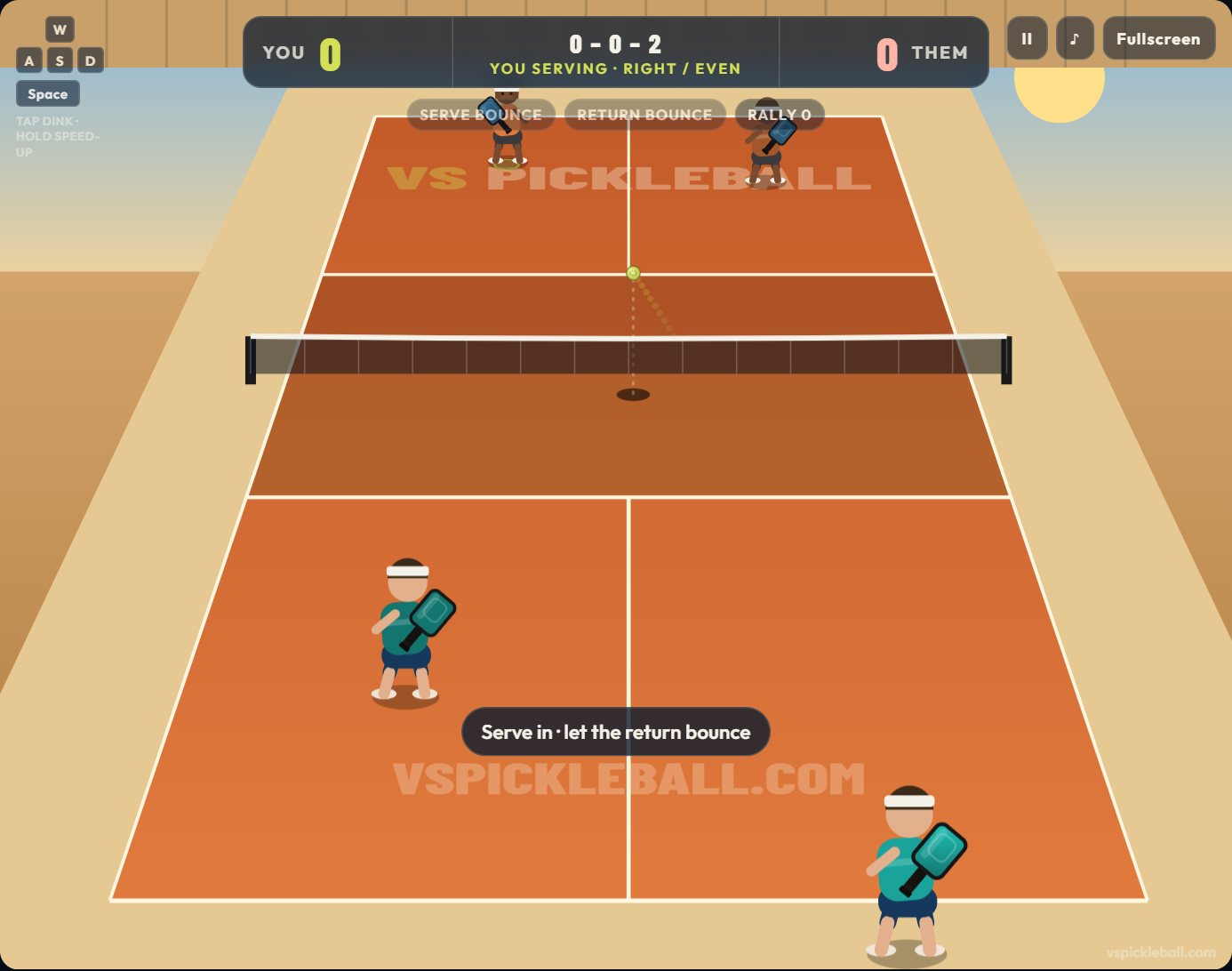
The free online pickleball game on this site has singles against the computer on three difficulty levels, doubles with an AI partner against two opponents, and local two-player singles on one keyboard. In doubles you control the player nearer the camera and your partner holds a lane; the first serve of the game is the one-server 0–0–2 sequence, and after that both players on a side serve before the side-out, exactly as above. The scoring is rally scoring rather than side-out, for reasons explained in the scoring guide. The how-to-play page has the controls for each mode.
Common questions
- Is the court the same size?
- Yes, 20 × 44 feet for both. No alleys.
- Does the two-bounce rule apply to singles?
- Yes. Serve bounces, return bounces, then volleys.
- In doubles, can either partner return the serve?
- No. Only the receiver diagonally opposite the server may return. The partner returning it is a fault.
- Can partners switch sides during a rally?
- Yes, freely. The position rules only apply at the moment of the serve.
- Do both partners serve before a side-out?
- Yes, except for the first serving turn of the game, which has only one server.
- Is mixed doubles played by different rules?
- No. Mixed doubles is the same game with one man and one woman per team; the rules are identical.
Keep going: the three-number call and the 0–0–2 start in pickleball scoring explained, and why the serving team is on the back foot in the two-bounce rule.
Or play doubles with an AI partner and see who takes the middle.